
6.18.2013


6.09.2013
Scored a Book Cover!!!

Rick Pracher, Art Director at Henry Holt and Company (http://us.macmillan.com/henryholt.aspx), researched artwork for the cover of Abundance: A Novel, he went looking for images that would juxtapose the ideas within the novel. His research brought him to my paintings. “I thought the description of the unusual beauty in something so destructive fit harmoniously with the novel,” Pracher remarked. The novel tells how a grandmother quietly accepts her fate but hopes one last visit from her family can heal a longstanding divide. The family slowly discovers the healing effect that a fight with cancer can have. Released on March 5th of this year, sales of the book have been modest, but reviews are very good and “the author loves the jacket,” says Pracher.
11.13.2012
Vincent van Gogh Starry Night
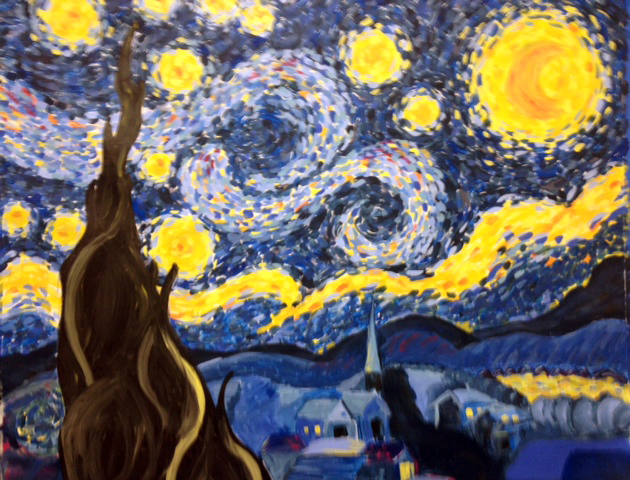 | |
| Finished painting by Angela Canada Hopkins, Copy of Starry Night. |
 |
| Yup, that's me painting. |
 |
| In progress. |
More info about the REAL artwork from Wikipedia, "The Starry Night (Dutch: De sterrennacht) is a painting by the Dutch post-impressionist artist Vincent van Gogh. The painting depicts the view outside his sanitorium room window at Saint-Rémy-de-Provence (located in southern France) at night, although it was painted from memory during the day. It has been in the permanent collection of the Museum of Modern Art in New York City, part of the Lillie P. Bliss Bequest, since 1941. One of Van Gogh's most popular pieces, the painting is widely hailed as his magnum opus." Link to site: http://en.wikipedia.org/wiki/The_Starry_Night
10.22.2012
5 Mind-Blowing Facts About Cells
 |
| Cell No.1, Acrylic on Canvas, by Angela Canada Hopkins |
1. There are two primary types of cells.
Eukaryotic and prokaryotic cells are the two main types of cells. Eukaryotic cells are called so because they have a true nucleus. Animals, plants, fungi and protists are examples of organisms that are composed of eukaryotic cells. Prokaryotes include bacteria and archaeans.
2. Your body has more bacterial cells than human cells.
Scientists have estimated that about 95 percent of all the cells in the body are bacteria. The vast majority of these microbes can be found within the digetive tract. If you take probiotics, you're helping to replenish these cells every day. See, not all bacteria is bad!
3. Cells can have sex.
Most prokaryotic cells reproduce by a process called binary fission. A cloning process where a single cell divides into two identical cells. Eukaryotic organisms have a similar type of reproductive method known as mitosis. But some eukaryotes also have the ability to reproduce sexually, which involves the fusion of sex cells or gametes.
4. Cells are super efficient packers.
Even though they're microscopic, each cell in your body has an estimated 6 to 8 feet of DNA, the genetic information necessary for directing cellular activities.
5. Cells don't worry about tomorrow.
Except for your brain cells, 50,000,000 of the cells in your body will have died and been replaced with others, all while you have been reading this sentence.
Got a mind-blowing cell fact I should know about? Share it in a comment!
10.15.2012
Where Does Artistic Inspiration Come From
 |
| Cell No.21, by Angela Canada Hopkins |
Inspiration from Place
Ever heard someone say, "I just need a change of scenery"? Where we choose to work or explore creative ideas can have a big impact on how inspired we feel. Some artists feel inspired when outdoors. Nature has many healing and calming properties, and spending some quiet time in a beautiful place can do wonders for your creative self.
Inspiration from People
Humans are social creatures. We crave attention, camaraderie, and affection. We love to do things with other humans. While solitude is important for concentration, isolation is the enemy of inspired art. When facing a creative block, denying yourself human contact will likely only make the problem worse. Go out for dinner with your friends. Play outside with your kids. Organize a movie marathon of every film your favorite actor has ever made. Reestablishing connections with stimulating people is a great way to kick-start inspiration.
Inspiration from Distraction
It is possible to become too involved in your creative work. Sometimes we're so immersed, we can't step back and view things as a whole. We lose our way, unsure if things are really as good as we think. We become paralyzed, and lose our inspiration. Although art is a passion, for many, it's also a career. We can be tempted to "keep our nose to the grindstone," ignoring all else in pursuit of
our goals. But sometimes distractions can be a good thing. Just a few weeks ago, the New York Times came out with a feature on artistic inspiration. Many of the professionals and experts interviewed said that distractions, doing something completely unrelated to their art, were the best way to break through a block. Read more here.
Where does your artistic inspiration come from? Share ideas/experiences in
a comment!
9.17.2012
How to Care for Canvas Artwork
 |
| Cell No.19, Angela Canada Hopkins © 2012 |
If you've purchased or are thinking about purchasing an original canvas artwork, you should know it will require a slightly different style of care to keep it looking good for years to come. Three things you must look out for as a fine art owner are Heat, Sunlight, and Moisture. These three conditions are deadly for canvas art, which is rarely hidden behind glass the way paper art is.
How To Frame Your Canvas Artwork
Framing is essential for quality presentation of your fine art, and is also an integral part of the preservation process. Canvas art is usually framed without glass. In most cases, your canvas art will already come stretched on a frame, but just in case it doesn't, make sure the canvas is†stretched properly on the supporting frame. This will minimize movement of the canvas over time, which often happens as a result of changes in temperature and humidity.
Where To Hang Your Canvas Artwork
After you've purchased and brought your new artwork home, the first thing to think about is placement. Never hang or place your canvas artwork directly above a heating unit, stove, or fireplace where it could be subject to high heat. You'll also want to avoid areas of direct sunlight, or pronounced humidity, like near windows or in bathrooms and kitchens. Heat, sunlight, and humidity are factors that might cause shrinking and expansion of the paint layer, that will result in cracks in the paint.
How To Clean Your Canvas Artwork
Well-loved canvas paintings often collect dust, but you can't just spray on some Pledge and wipe it away. Water and chemical-based cleaners are deadly to canvas artwork. Instead, use a dry lint-free cloth or feather duster to remove any debris that may have settled on the painting. Every few months or so, take the painting off the wall and turn upside down gently to dislodge any larger pieces.†Paintings should be removed from the wall twice a year and the back of the painting should be examined for any signs of cracking or woodworm damage.
When To Seek Professional Help
If you ever notice cracks, waves or bumps, or yellow spots on your canvas artwork, those are signs that serious damage is on the horizon. It's time to bring the painting to a professional to let them re-stretch or restore sections that are affected.

9.10.2012
What does a "real" cancer cell look like?
 |
| Acrylic on Canvas painting by Angela Canada Hopkins |
"Are they "real" cancer cells?" This is the most frequently asked question by viewers of my paintings. The quick answer is, no, they are not realistic medical illustrations. They are, for the most part, conceptual where the idea and content are central.
The cells are invisible underneath the surface and almost don't seem real. If you've had cancer or been affected by it I'm sure you know what I'm talking about. You feel the effects of it but you never stop to ask, what is it? In fact you want to run if someone even mentions the "C" word.
It took me many years before I was ready to ask questions. After researching cancer and studying photographs I wanted to replace my memory and thoughts with something positive. I wanted to make it "real" in my artistic way. The colorful and beautiful cell paintings are my way of taking control and overcoming everything negative to do with the terrible disease.
If you'd like to know what a "real" cancer cell looks like, you'd need a scanning electron microscope, or visit these sites to see photographs:
Environmental Graffiti
Science Photo Library
National Cancer Institute
Subscribe to:
Posts (Atom)
LinkWithin
